
InstaStore
InstaStore
Turning Instagram Feeds into Your Own E-commerce
Context & Hook
For millions of small business owners in Indonesia (UMKM), Instagram isn't just a social network—it's their primary storefront. But as a business grows, "DM for price" stops being a strategy and starts being a bottleneck. I watched friends struggle to manage orders through chat logs and realized: they don't need a complex website builder like Shopify that forces them to start from scratch. They need something that works with the content they already have.
The Real Problem
The core issue wasn't just "building a website"—it was data fragmentation. Small business owners already have thousands of product photos and descriptions live on Instagram, but that data is unstructured and trapped in a "walled garden."
Most competitors ask users to manually re-upload photos and re-type descriptions. For a solo entrepreneur, this duplication of effort is paralyzing. They needed a bridge that could transform their existing chaos into a structured, transactional platform without changing their workflow.
My Approach & Decisions
My initial hypothesis was aggressive: "Can I scrape an Instagram profile and build a fully functional store in under 60 seconds?"
To achieve this, I had to navigate two major constraints:
- Platform Resistance: Building a reliable scraper (using Playwright and Crawlee) was a constant battle against rate limits and anti-bot measures.
- Unstructured Data: Instagram captions are creative writing, not database entries. You can't effectively regex "Price: 50k" when it's buried in emojis, line breaks, and colloquial slang.
The Pivot to AI:
Early attempts with standard parsing logic failed. The breakthrough came when I decided to treat the extraction layer as a probabilistic problem rather than a deterministic one. I integrated OpenAI to process the raw caption text with a strict schema: "Extract the product name, clean up the description, and identify the price key from this mess." This decision transformed a brittle 40% success rate into a robust 95% accuracy rate, turning messy paragraphs into structured database rows instantly.
Execution & Outcome
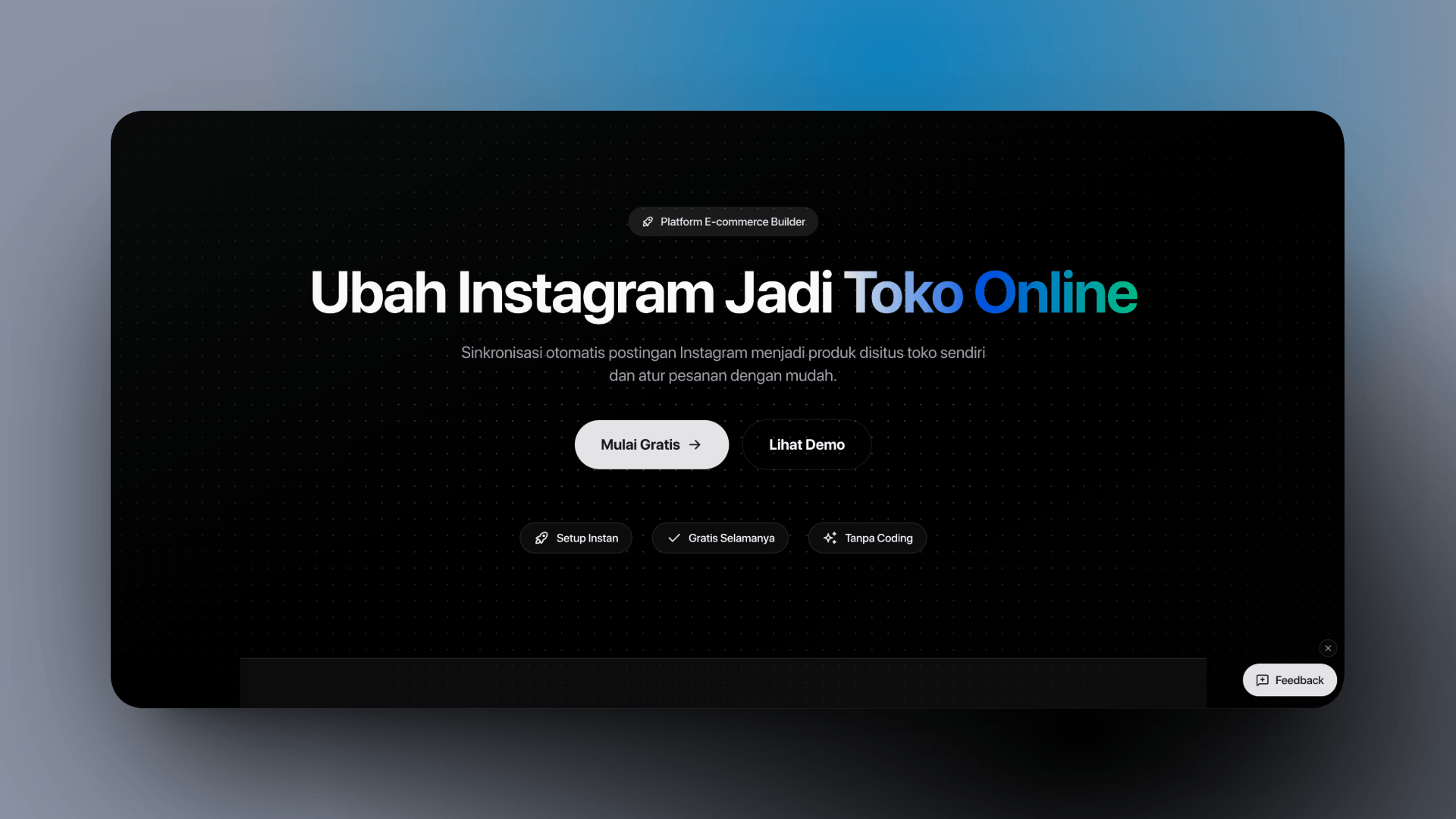
InstaStore operates as a "sync-first" e-commerce engine. A user simply types their Instagram username, and the system handles the heavy lifting:
- Ingestion: Distributed processing nodes (running on VPS) navigate the profile to fetch media responsibly.
- Intelligence: AI transformers analyze captions to extract product meta-data (Price, Name, Variants) and normalize it.
- Commerce: A fully deployed Next.js storefront is generated instantly, complete with local payment integrations (QRIS, Xendit).
The Result:
Users can go from a public Instagram profile to a searchable, shareable e-commerce catalog in under a minute. The friction of "setup time" was effectively reduced to zero.
Reflection & Growth
This project taught me that "advanced" tech is most powerful when it becomes invisible. The user doesn't care about the BullMQ job queues managing the scrapers or the PostgreSQL transactions ensuring data integrity; they just care that their 300 Instagram posts are now a sellable catalog. It shifted my perspective from building for developers to building for the real economy—solving a business problem where the technology is the quiet enabler, not the loud protagonist.
Technical Stack
- Frontend: Next.js 15, TailwindCSS, Framer Motion, Radix UI
- Backend: Next.js Server Actions, Prisma, PostgreSQL
- Automation: Playwright, Crawlee, BullMQ (Redis)
- AI: OpenAI API (Caption parsing & data structuring)
- Payments: Midtrans, Xendit, QRIS (Generated via custom implementation)
- Infrastructure: Vercel (Web), VPS (Worker Nodes for Scraping)