
ZenTik
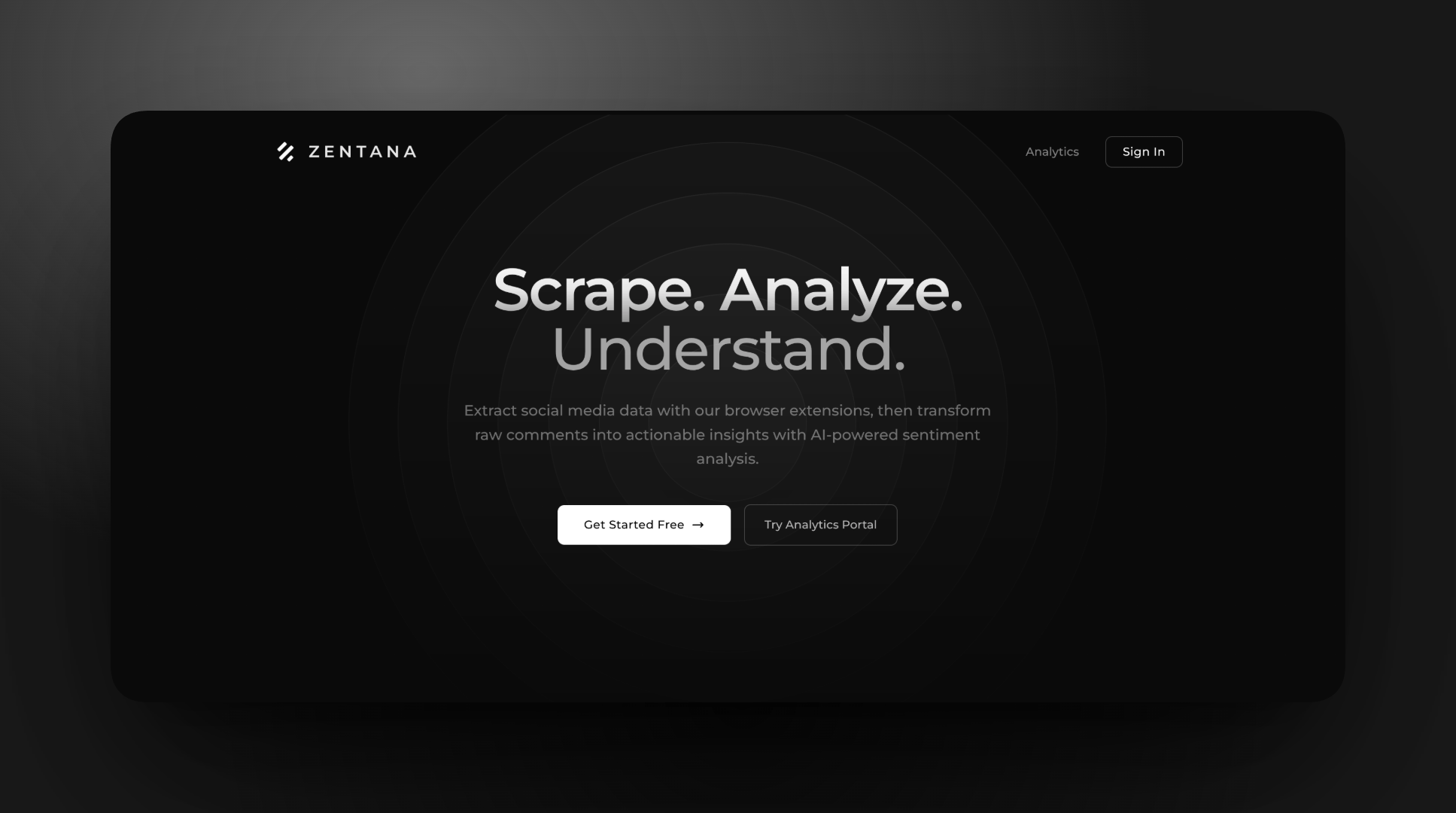
Zentana - Tiktok
Bridge the gap between raw social data and actionable strategy
The "Black Box" of Viral Engagement
For modern brands and creators, TikTok is a high-stakes arena. Millions of unintended marketing dollars are wasted because while platforms show how many people watched a video, they rarely explain why. Community sentiment—the gold standard of feedback—is buried in thousands of comments that are impossible to read manually and technically difficult to scrape.
Marketers were left with two bad options: trust their gut (risky) or pay thousands for enterprise-grade social listening tools (expensive). I wanted to democratize this data intelligence.
The Real Problem
The challenge wasn't just analyzing data; it was accessing it. TikTok’s anti-churn & anti-scraping measures are some of the most sophisticated in the world. Traditional web scraping methods (headless browsers, rotating proxies) are fragile, expensive, and constantly getting blocked. I needed a way to reliably extract thousands of data points without triggering security tripwires or bankrupting the user with proxy costs.
Strategic Decisions & Trade-offs
1. "Leech" Architecture vs. Cloud Scraping The standard fast approach would have been building a server-side scraper using Python/Selenium.
- The Trap: This turns into a "cat-and-mouse" game with platform firewalls, requiring constant maintenance and expensive residential IP proxies to avoid bans.
- The Decision: I built a browser extension (Zentik) that piggybacks on the user's existing, authenticated session. Instead of a bot trying to break in, the extension acts as a "power user" browsing naturally.
- The Trade-off: This requires the user to keep their browser open (client-side dependency), but it guarantees a near-100% success rate with zero marginal cost for proxies.
2. Decoupled Extraction & Analysis I had to decide where the heavy lifting happens.
- The Decision: I adopted a hybrid approach. Extraction happens locally in the browser (leveraging the user's CPU and bandwidth). Analysis moves to the cloud (Zentana Platform), where I use server-side AI to process sentiment and generate visualizations.
- The Impact: This keeps the extension lightweight and compliant with store policies, while the web platform becomes a high-value "Command Center" where I can monetize premium storage and AI features.
Execution
I architected Zentana as a dual-interface ecosystem:
- The Collector (Extension): Built with WXT and React for cross-browser compatibility. It injects non-intrusive UI overlays into TikTok, allowing 1-click export of video, user, and comment data.
- The Brain (Web Platform): A Next.js dashboard that ingests the raw data. I implemented a credit-based system where users pay to "unlock" AI sentiment analysis, using custom visualization libraries (Recharts) to turn spreadsheet rows into trend lines and sentiment pies.
Outcome & Growth
Zentana transforms a 4-hour manual research task into a 5-minute automated workflow. By respecting the platform's constraints rather than fighting them, I built a tool that is both robust and scalable. This project sharpened my ability to think about system design from a cost/benefit perspective—sometimes the best engineering solution isn't the most complex one, but the one that aligns best with the user's reality.
Role: End-to-End Developer (Solo Founder)
Timeline: January 2026 - Present
Tech Stack: Next.js, TypeScript, WXT (Web Extension Framework), TailwindCSS, NextAuth, Huggingface (Sentiment)